

The NYS Excelsior Scholarship is one of the most talked-about college programs in the United States and also one of the most misunderstood.
On the surface, it promises free tuition in New York. But many students and parents later discover conditions they didn’t fully understand: credit requirements, income limits, and a post-graduation residency obligation.
If you’re asking:
- What is the NYS Excelsior Scholarship?
- How does the NYS Excelsior Scholarship work?
- How do I apply?
- Does it really mean free college?
- Are there strings attached?
This guide breaks it all down clearly, honestly, and in plain language.
What Is the NYS Excelsior Scholarship?
The NYS Excelsior Scholarship is a state-funded tuition assistance program created by the State of New York to make college more affordable for middle-income families.
It covers tuition costs only for eligible students attending:
- SUNY (State University of New York) schools
- CUNY (City University of New York) schools
It does not cover:
- Room and board
- Books
- Fees
- Transportation
- Meal plans
How Does the NYS Excelsior Scholarship Work?
The Excelsior Scholarship is a last-dollar program.
That means:
- Federal aid (like Pell Grants)
- State aid (like TAP)
- Other tuition-specific scholarships
…are applied first.
Then, Excelsior covers any remaining tuition balance—up to the full in-state tuition amount.
If your other aid already covers tuition, Excelsior provides $0, even if you qualify.
Who Is Eligible for the NYS Excelsior Scholarship?
Basic Eligibility Requirements
To qualify, students must:
- Be a New York State resident
- Attend a SUNY or CUNY school
- Enroll full-time (30 credits per year)
- Meet income limits
- Be on track to graduate on time
Income Limits (Household Adjusted Gross Income)
- Current limit: up to $125,000
Income is based on prior-year tax returns, not current earnings.
NYS Excelsior Scholarship Credit Requirement (Very Important)
This is where many students run into trouble.
You must:
- Complete 30 credits every academic year
- Stay continuously enrolled
- Avoid falling behind due to dropped classes or failed courses
If you earn fewer than 30 credits in a year, you may:
- Lose eligibility
- Be required to repay the award
Summer and winter credits may count, but rules are strict.
How to Apply for the NYS Excelsior Scholarship
Step-by-Step Application Process
- Complete the FAFSA
- Complete the NYS TAP application
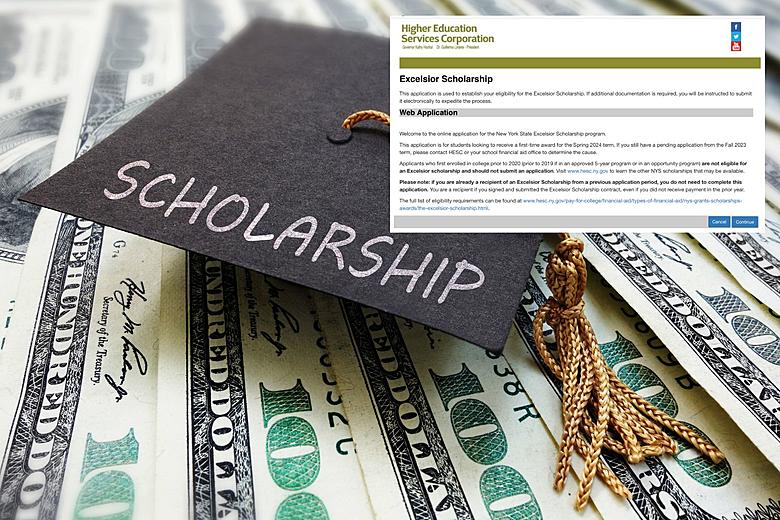
- Apply through the NYS Higher Education Services Corporation (HESC) portal
- Submit all documentation by the deadline
- Accept the award if approved
Missing any step can disqualify you—even if you meet income requirements.
NYS Excelsior Scholarship Deadline
Deadlines vary by academic year, but typically:
- Application opens: Spring or early summer
- Deadline: Mid-to-late summer (before fall semester)
There is no automatic enrollment. You must apply every year.
Does the NYS Excelsior Scholarship Require You to Stay in New York?
Yes—this is one of the most important conditions.
Residency & Work Requirement
After graduation, recipients must:
- Live and work in New York State
- For the same number of years they received the scholarship
If you leave New York:
- The scholarship converts into a loan
- Repayment becomes mandatory
This requirement applies even if:
- You get a better job offer elsewhere
- You attend graduate school out of state
- You move for personal reasons
Is the NYS Excelsior Scholarship Taxable?
This is a common question.
Generally:
- Tuition assistance used for qualified education expenses is not taxable
- However, tax treatment can vary depending on circumstances
Students should consult a tax professional if unsure.
Does a 401(k) Affect the NYS Excelsior Scholarship?
Another common concern.
- Income eligibility is based on adjusted gross income (AGI)
- Certain retirement contributions can affect AGI
- However, this depends on individual tax situations
Families close to the income limit should plan carefully.
Is the NYS Excelsior Scholarship Really “Free College”?
Not entirely.
What It Covers
- Tuition only
- In-state rates only
- SUNY/CUNY schools only
What It Does NOT Cover
- Housing
- Food
- Fees
- Books
- Transportation
Students should still budget for thousands of dollars per year in non-tuition costs.
Pros and Cons of the NYS Excelsior Scholarship
Pros
- Can eliminate tuition costs
- Helps middle-income families
- Encourages on-time graduation
- Supports SUNY and CUNY students
Cons
- Strict credit requirements
- Post-graduation residency obligation
- No help with living expenses
- Not flexible for career mobility
Who Should (and Shouldn’t) Use the Excelsior Scholarship
Good Fit If You:
- Plan to live and work in NY long-term
- Can maintain full-time enrollment
- Have a clear graduation path
- Attend SUNY or CUNY
Risky If You:
- Might move out of state
- Are unsure about major/career path
- Need flexibility in course load
- Expect interruptions in enrollment
Frequently Asked Questions (SEO-Optimized)
What is the NYS Excelsior Scholarship?
A New York State program that covers tuition at SUNY and CUNY schools for eligible students.
How does the NYS Excelsior Scholarship work?
It covers remaining tuition after other aid is applied.
How do I apply for the NYS Excelsior Scholarship?
By completing FAFSA, TAP, and the Excelsior application through NYS HESC.
Is the NYS Excelsior Scholarship free money?
Only if you meet all requirements; otherwise, it can convert to a loan.
Does the scholarship require staying in New York?
Yes, for the same number of years you received the award.
Final Thoughts: Is the NYS Excelsior Scholarship Worth It?
The NYS Excelsior Scholarship is neither a scam nor a miracle—it’s a policy tool with clear trade-offs.
For students who:
- Plan to stay in New York
- Can handle full-time enrollment
- Want predictable tuition costs
…it can be extremely valuable.
But for students who need flexibility, mobility, or part-time options, the obligations can outweigh the benefits.
The key is understanding the rules before you apply, not after you graduate.
Discover more from USASEOIT
Subscribe to get the latest posts sent to your email.
Leave a Reply